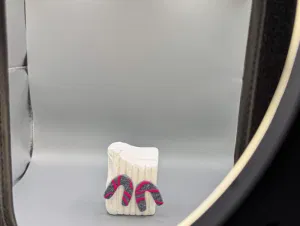
Lightweight statement earrings are oversized, sculptural designs that create visual impact using volume, negative space, and balance—not dense metal. The goal is simple: bold style that stays comfortable for hours.
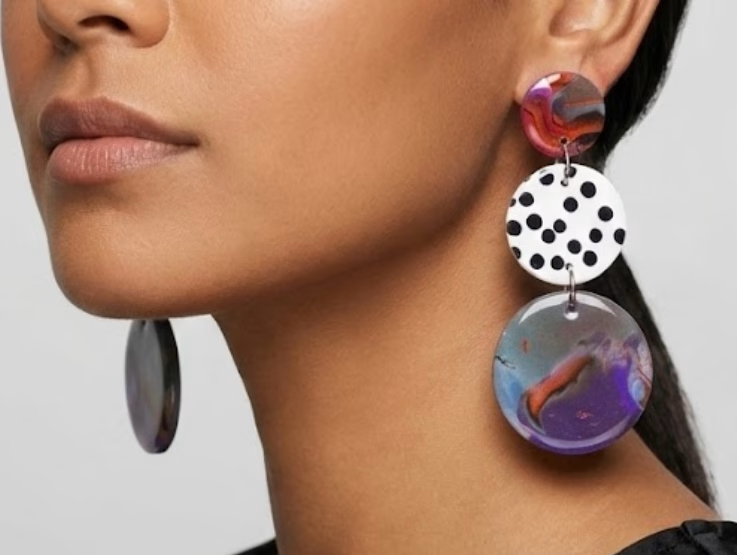
At Blueberry Bloom in Vienna, I hand-sculpt abstract statement earrings so you can wear them all day—from a morning meeting in the 1st District to dinner in Hietzing—without the constant “are my ears okay?” check in the mirror.
Because we’ve all lived the same story: you put on the perfect pair, you feel unstoppable… and two hours later you’re discreetly taking them off at the table like they’re punishment. For a long time fashion sold us the idea that beauty is pain. In 2026, we’re done with that.
What I make is jewelry designed to fit your life—not jewelry you endure for a photo.
- The Science of Comfort: Why 7.5g Is a Helpful Benchmark
- Comfort Isn’t Just Weight: It’s Balance, Leverage, and “The Sit”
- Material Safety: EU Nickel Rules and Sensitive-Ear Choices
- How “Big” Can Be Lightweight? The Design Trick Is Volume Without Mass
- Abstract Over Ordinary: Why These Designs Stay Stylish Longer
- How to Style Sculptural Earrings Without Overthinking It
- Slow Fashion from Vienna-Hietzing: A Smaller, Cleaner Way to Buy Jewelry
- Care Guide: Keep Them Beautiful (and Keep Plating Happier)
- FAQ: Quick Answers
- Find Your Signature Pair
The Science of Comfort: Why 7.5g Is a Helpful Benchmark
Let’s talk about what “lightweight” actually means in real life.
Heavy earrings can cause genuine discomfort, and frequent long wear may contribute to stretching over time—especially if earrings are front-heavy or worn for years. In medical language you’ll sometimes see terms like earlobe ptosis (sagging), but you don’t need medical vocabulary to understand the practical point: your earlobe is soft tissue, and constant downward pull adds up.
A simple, memorable reference: the 1-Euro coin
A standard 1-Euro coin weighs 7.50 g. It’s a useful benchmark because it’s something almost everyone has held and can “feel” in their mind.
Here’s the way I think about it:
- Around 7.5 g per earring is where many people start noticing weight during long wear.
- Over ~10 g per earring is commonly where discomfort becomes more likely—especially if the design tilts forward or swings heavily.
- Comfort is personal (piercing placement, lobe size, sensitivity), but lighter is almost always easier.
What this looks like at Blueberry Bloom
Most Blueberry Bloom designs are made to stay between 3 g and 6 g per earring—so you get the drama of a sculptural silhouette while staying well under that “coin-weight” feeling.
Quick comparison:
- 1-Euro coin: 7.50 g
- Many metal statement earrings: often ~15–25 g per earring (varies wildly by design)
- Blueberry Bloom sculptural earrings: 3–6 g per earring
But here’s the part most brands skip: weight is only half the comfort equation. The other half is how that weight sits.
Comfort Isn’t Just Weight: It’s Balance, Leverage, and “The Sit”
Two earrings can weigh the same and feel completely different.
That’s because comfort is also about:
- Center of gravity: where the “pull” sits relative to your piercing
- Leverage: how far the mass sits from the lobe (longer shapes can feel heavier)
- Stability: does it sit flush, or does it tip forward and tug?
How I design for the “sit”
- Post placement + testing: I position the post so the earring sits flush and resists forward-tilt. (This is one of those invisible details you only notice when it’s done right.)
- Pressure distribution backings: My Comfort Clutch backings use a wider disc to spread contact across more of the lobe—less pinch, more stability, fewer mid-day adjustments.
In plain terms: if the earring doesn’t fight your ear, you forget it’s there. That’s the goal.
Material Safety: EU Nickel Rules and Sensitive-Ear Choices
If you have sensitive ears, you already know “hypoallergenic” gets thrown around too casually. What matters is material choice and regulatory limits.
EU nickel requirements (the practical takeaway)
Under EU rules (REACH restrictions on nickel release), jewelry intended for direct and prolonged skin contact must stay below strict nickel release limits. Importantly, items inserted into pierced parts of the body have an even stricter limit than surface-contact jewelry.
What this means for you as a buyer: good-quality components matter, and sourcing isn’t just aesthetics—it’s skin comfort.
What I use at Blueberry Bloom
- 316L stainless steel: widely used for body-jewelry components thanks to its corrosion resistance and stability. It contains nickel as part of the alloy, but it’s chosen because it’s designed to resist corrosion and reduce release under normal wear conditions.
- Gold-plated stainless steel (selected components): gold plating can act as an additional barrier while it remains intact. (Real talk: plating can wear over time depending on friction, sweat, perfume, and storage—so care matters.)
If you have a known metal allergy, I always recommend listening to your body first. “Sensitive-ear friendly” isn’t one-size-fits-all—it’s about your personal sensitivity plus component quality.
How “Big” Can Be Lightweight? The Design Trick Is Volume Without Mass
A sculptural earring looks bold because it has presence—not because it’s made of a dense chunk of metal.
In my Hietzing home studio, I build that presence through:
- form and negative space (so your eye reads “large,” not “heavy”)
- balanced proportions (so the earring feels steady instead of front-loaded)
- hand-finishing for a smooth, gallery-quality feel
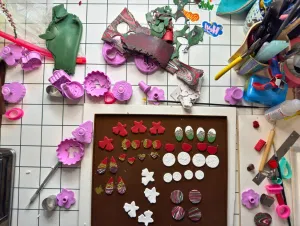
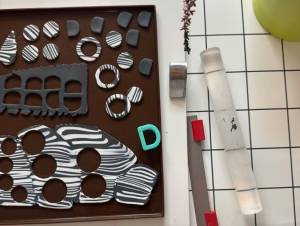
Every pair is made slowly and intentionally: shaping, curing, sanding, finishing. No assembly lines. No “just good enough” shortcuts. If you’ve ever held something that was truly handmade, you know the difference: the edges feel considered, and the piece has a quiet confidence.
Abstract Over Ordinary: Why These Designs Stay Stylish Longer
I love abstraction because it doesn’t shout a literal theme. It doesn’t lock you into one mood or one season.
One person sees flowing river lines. Another sees architectural silhouettes. Someone else sees alpine textures and stone. That openness is what makes abstract jewelry feel modern—and why it plays so well with so many outfits.
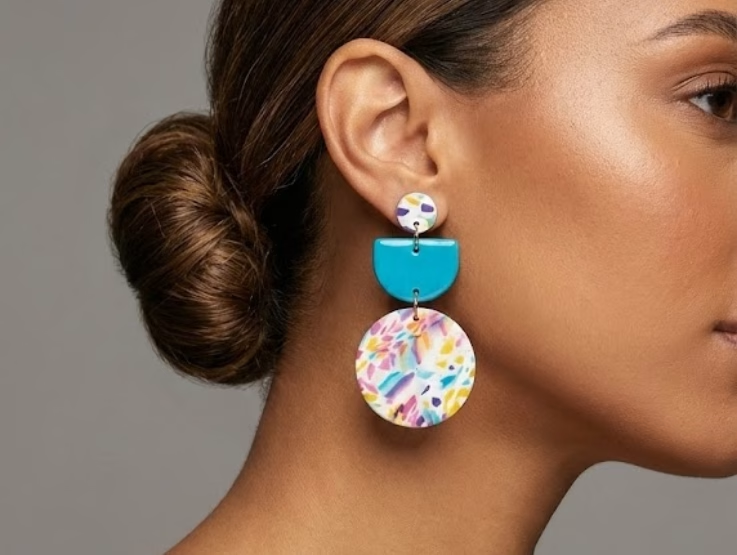
How to Style Sculptural Earrings Without Overthinking It
If you’ve ever hesitated and thought “I love them, but can I pull them off?” — yes. Here’s the cheat sheet:
- Choose one hero piece. Let the earrings be the star; skip the chunky necklace.
- Show the silhouette. Hair tucked behind the ears or a loose bun works every time.
- Echo one detail. Match one small element (bag, shoes, scarf, eyeliner) to a tone in the earrings for a polished look.
- Mix textures, not chaos. Sculptural earrings look amazing with linen, silk, knits, and clean tailoring.
Slow Fashion from Vienna-Hietzing: A Smaller, Cleaner Way to Buy Jewelry
Blueberry Bloom is my answer to the throwaway cycle of mass production.
- Small batch, made by me: every pair is designed and crafted in Vienna.
- Low-waste mindset: leftover material is reworked into new patterns whenever possible—less waste, more one-of-a-kind character.
- Plastic-free packaging: your order arrives gift-ready in recyclable cardboard packaging.
If you’re buying less but buying better, this is exactly that kind of piece.
Care Guide: Keep Them Beautiful (and Keep Plating Happier)
To keep your earrings looking fresh:
- Wipe gently with a soft, slightly damp cloth after wear.
- Avoid direct contact with perfume, hairspray, and harsh cleaners.
- Don’t store them loose in a bag with keys or metal jewelry (friction matters).
- If your piece includes gold-plated components, store it dry and avoid heavy rubbing—plating lasts longer when treated gently.
FAQ: Quick Answers
Find Your Signature Pair
If you’re ready for bold style without the compromise, browse the shop and discover handmade unicates your ears will genuinely love.
Free shipping in Austria on orders over €50.
Based in Vienna? Reach out via our Contact page to arrange local pickup from the Hietzing studio.